Why Are Charizard Cards So Expensive? What a Charizard Is Actually Worth
Charizard costs far more than Blastoise or Venusaur from the very same sets. Here is the data on how much more, why it is brand not rarity, and how to value yours.
In this guide
Charizard is the card everyone asks about, and the instinct is right: it really does cost more than almost anything around it. The interesting part is why. It is not that Charizards are rarer than other cards in the same set, they are not. It is that Charizard is the most wanted name in the hobby, and demand, not rarity, sets the price.
Charizard costs more than its own rivals
Charizard, Blastoise and Venusaur are the three Kanto starters: same era, same sets, same rarity tiers, same "final evolution" status. If rarity set the price they would trade for about the same. They do not. We took the median trend price of every printing of each, and the typical Charizard trades at around €36, versus about €21 for Blastoise and €22 for Venusaur. That is roughly 1.6 to 1.7x its own starter rivals, for cards printed side by side. The full breakdown is in the Charizard tax study. The gap is not rarity, it is brand.
It even out-taxes Pikachu
You would expect the mascot to be the most valuable Pokemon, but the typical Charizard (€36) trades at about 2.9x a typical Pikachu (€12), and about 2.2x a typical Mewtwo. Charizard is simply the single most collected Pokemon, so its whole price curve sits higher than everyone else's, from bulk commons up to the grails.
The chase Charizards (and why yours probably is not one)
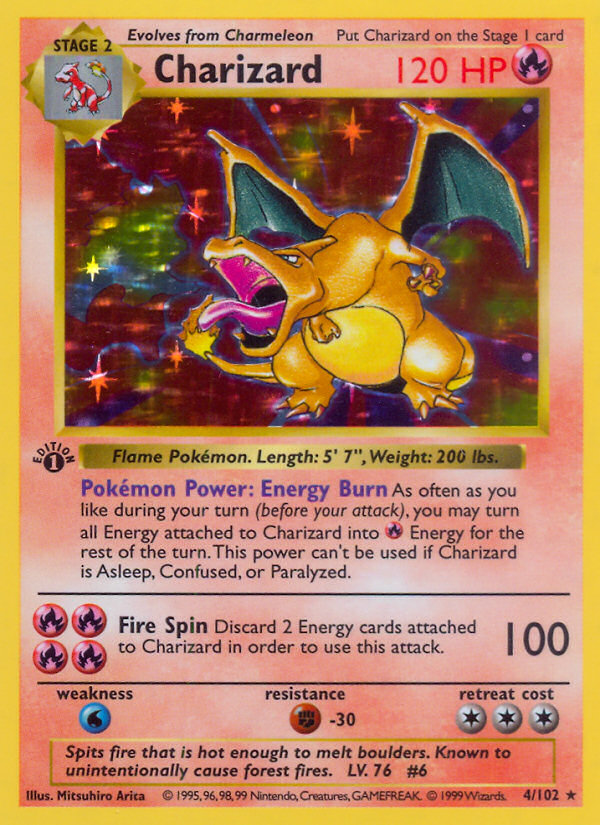
The top of the Charizard market is genuinely wild: the Base Set Charizard trends around €2,712, and about 29% of all Charizard printings are worth €100 or more. But that cuts both ways. The typical Charizard is €36, not four figures, because Charizard has been printed constantly for decades. So the single biggest mistake is assuming any Charizard is a jackpot. The exact printing decides everything: the set, the year, the rarity, holo vs non-holo, first edition vs unlimited. A 1999 Base Set holo and a modern reprint of the same art are worlds apart in price.
Why brand beats rarity
Two things stack. First, Charizard has the deepest collector demand of any Pokemon, spanning nostalgia, cross-generational recognition, and the trophy status of the Base Set card. Second, that demand applies to every Charizard printing at once, so even ordinary ones clear the bulk bin. Scarce-and-wanted is what makes a premium, and Charizard maxes out the "wanted" half harder than any other card, which is exactly why the premium shows up across its whole catalog rather than on one card.
How to value your Charizard
- Pin the exact printing: set, card number, holo or non-holo, and first edition vs unlimited.
- Filter to English, Near Mint or better (condition matters most on the expensive vintage ones).
- Average the four lowest current offers for that exact printing. That is what it genuinely sells for.
That is the method from what's my trading card worth, applied to Charizard specifically. To identify the exact printing and pull its live value fast, scan a card →. If it is a vintage Base Set Charizard in high grade, it is exactly the kind of card where grading can be worth it.
Selling a Charizard
Charizard is the one card where buyers are most careful, so a precise, honest listing wins. Name the exact printing and condition, price the right market, and open a free shop and list your cards → with no marketplace fee. If it is a high-value one, ship it safely so it arrives in the grade you sold.