How to Value Digimon Cards: Number, Version, Language, Condition
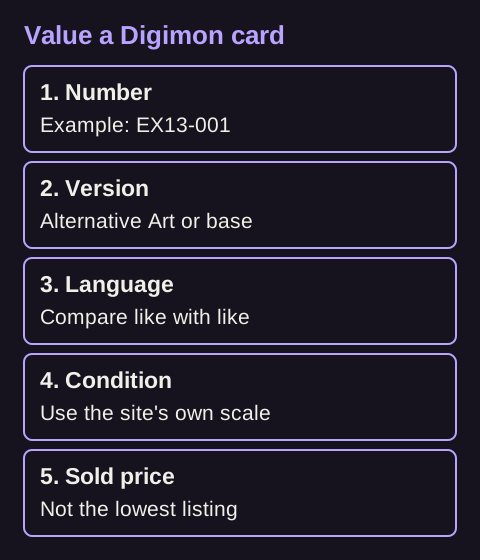
To value a Digimon card, match its number, version and language, grade it honestly, then read sold prices for that exact copy. Here is the routine.
In this guide
A Digimon card is worth what the exact same copy recently sold for. So find its number first, then its version, language and condition, and only then read a price.
This guide is the how-to. For which Digimon cards earn real money and what our data found, read are Digimon cards worth money.
Step 1: find the number and rarity
Look at the coloured bar with the card's name. The official rule manual marks the details at its right end: the card number on top, with the rarity letter and the block icon just below.
Its example card reads ST23-06, with a small R and a 06 beneath. If your card lays this out differently, compare it with the official card list.
The part before the hyphen matches the product: EX13 cards belong to the set the list calls EX-13. Search that number instead of the Digimon's name, because MetalGreymon alone has many different cards.
The list's rarity filter uses these labels: C, U, R, SR, UR, SEC and P. Rarity narrows the search, but it does not set the price.
The comprehensive rules say the block icon shows the period when a card was released. Note it down when you compare two copies of one number.
Step 2: pin the exact version
The rules treat cards with the same name and number as the same card. The market does not, and this step decides most Digimon prices.
The official list gives "Alternative Art" versions their own entries and has a Yes/No filter for them, so you can see every art that shares your number.
Alternative versions reach the market in different ways. On Release Special Booster Ver.1.5, each box held one random parallel design card, and a Dash Pack held alternate art versions.
Here is the gap on two cards, using TCGplayer Market Prices from the TCGCSV public price file stamped 2 November 2026. Prices move, and the file does not state a condition.
| Card | Version | Market Price |
|---|---|---|
| MetalGreymon BT10-024 | Xros Encounter | $0.99 |
| MetalGreymon BT10-024 | Alternate Art | $10.92 |
| MetalGreymon BT10-024 | Special Event Pack 2025 | $1.37 |
| Jesmon GX BT10-112 | Xros Encounter | $6.58 |
| Jesmon GX BT10-112 | Tamer's Evolution Box | $2.89 |
The first three rows show one number at three prices. The Jesmon rows show the reverse trap, because a later version can sit below the first one.
Hold your card next to the picture on the product page. If the art differs, you are on the wrong page.
Step 3: check the language
Bandai names four language versions: Japanese, English, Simplified Chinese and Korean. That page, dated 25 December 2025, also lists which regions may play each one.
Value each language against sales in the same language. CardTrader has a language filter with those same four, so use it before you read a figure.
Step 4: grade the condition honestly
Marketplaces do not share one scale, so check the scale of the site you are reading. Cardmarket uses M, NM, EX, GD, LP, PL and PO, and CardTrader's guide uses NM, SP, MP, PL and PO.
Cardmarket is strict on one point: cards with whitened borders must be offered as Poor. Check your edges under a bright lamp before you assume Near Mint.
Our card condition guide shows what each grade looks like. Grading fees only make sense on some cards, so read is grading worth it before you post anything.
Step 5: read a real price
Filter the marketplace to your version, language and condition. Then read these figures in this order.
| Where | Figure | What it tells you |
|---|---|---|
| TCGplayer | Market Price | Built from recent completed sales on TCGplayer |
| TCGplayer | Most Recent Sale | The last sale for your filters |
| Cardmarket | Price Trend, 30-days average | Cardmarket's own figures. We could not find the formula |
| Cardmarket | From | The cheapest listing, which may be a worse copy |
| eBay | Sold items filter | What buyers paid, but check every photo |
We describe the eBay filter from an eBay Community thread, not an official help page. Users there say it can be missing in some app views, and that sold results reach back about 90 days.
When a card has few sales, one sale proves little. TCGplayer marks products with too few sales as Indeterminate Volatility, so collect several sold prices instead of trusting one.
The table above stays in dollars because a security check kept us off Cardmarket's product pages that day.
Valuing a whole pile
Sort first, because looking up every common wastes an evening.
- Pull every Alternative Art and P card, plus SR, UR and SEC.
- Look up that stack by number and version.
- Sample a few cards from each product in the rest.
- Write down the number, version, language, condition and price for every card worth selling alone.
If the collection was inherited or is large, valuing an inherited collection has a fuller routine. Before you buy anything to complete a set, read how to spot fake trading cards.
What people ask next
- Which Digimon cards are actually worth money?
- How do I value a stack of cards from any game?
- What do NM and LP really mean?
- Should I grade my best card?
- Which Digimon sets are coming next?
FAQ
What if I cannot read the number?
Search the Digimon's name in the official list and compare the pictures. Each entry shows the number and rarity together.
Does rarity tell me the value?
Only roughly. Rarity tells you which pile to check first, and the version and sold prices tell you the value.
Is a Japanese Digimon card worth less than an English one?
There is no fixed rule to rely on. Look up sold prices for the same version in each language and compare them card by card.
What does SP mean on Digimon listings?
Be careful with it. The official rarity filter has no SP label, and on CardTrader's condition scale SP means Slightly Played, so read what the site means before you compare.
What does UR mean?
UR is one of the labels in the official rarity filter. We could not find a Bandai page that spells it out, so we leave it at the label, and you can look up each UR card by its number.
Find your card
See the shops → Independent shops on Foilio. On an order you pay the seller directly.
Foilio does not hold the payment and does not guarantee the deal.
Check a card price → Look up your Digimon number on Foilio, then set that figure beside recent sales.