Are Japanese Pokémon Cards Worth More Than English?
Japanese Pokémon cards hold value differently: far less bulk, a higher price floor, and the real chase is event promos, not the rarity symbol. Here is the data.
In this guide
Japanese Pokemon cards feel special, the print quality is famously sharp, and collectors often assume they are simply worth more. The truth is more interesting than a flat yes. Japanese Pokemon does not have more expensive versions of every card, but it holds value differently: there is far less bulk, the floor is higher, and the real money hides somewhere the rarity symbol will not tell you.
Japanese Pokemon barely has bulk
We priced 19,605 Japanese singles across 448 sets. Only 41% of them trade under $1, and the median card is $1.69. For comparison, across the major games 60 to 90% of cards are sub-$1 bulk. So the standout fact is the floor: ordinary Japanese cards stay off the bulk pile far more often than Western ones, because Japanese collector demand lifts the whole price base. The full data is in the Japanese Pokemon market study.
The rarity symbol lies
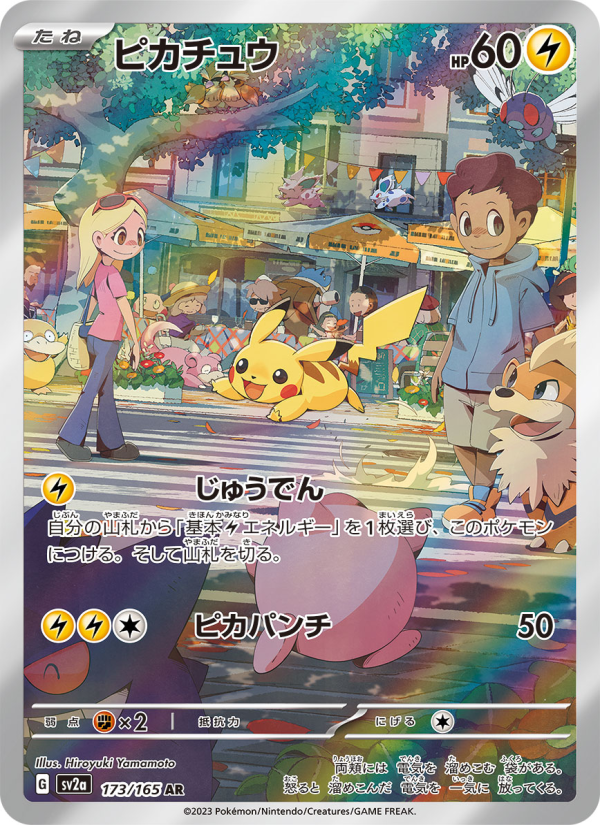
Here is the quirk that catches people out: the single most valuable card in the data is a Pikachu (227/S-P) worth about $1,799, and it is filed as a "Common". In the Japanese market, the biggest prices sit on exclusive event and campaign promos (the S-P and XY-P series), which are chased for their scarcity, not for any rarity stamp. So you cannot read a Japanese card's value off its rarity symbol the way you might in English. If you want to actually read Japanese rarity marks, see how to tell if a Pokemon card is rare, then check the price regardless of the symbol.
The modern chase: Special Art Rare
Among standard pull rarities, the modern chase is the Special Art Rare, with a typical price around $26, Japan's answer to the English Special Illustration Rare. The tiers climb from there: Super Rare around $4.39, Art Rare $4.80, Ultra Rare $7.19, vintage Holo Rares around $20, then Special Art Rares at $26 and up. As always, those are typical (median) prices, individual chase cards go far higher.
So, are they worth more?
Honestly, it depends what you mean. Japanese cards are not automatically a pricier copy of the same English card, and this study does not measure a card-for-card premium. What the data does show is that Japanese Pokemon has a higher floor (much less bulk) and eye-watering tops on event promos. So a random Japanese card is more likely to be worth something than a random English one, but the way to know is the same for both: value the exact card, do not assume from the language or the symbol.
How to value a Japanese card
- Pin the exact printing: the Japanese set and card number (for example 227/S-P), and whether it is a promo.
- Filter to Near Mint or better, on the Japanese printing specifically, not the English one.
- Average the lowest current offers for that exact card. That is its real price.
This is the what's my trading card worth method, applied to the Japanese printing. To identify the exact card and pull its live value without reading Japanese set symbols by hand, scan a card →.
Selling Japanese cards
Japanese buyers are precise, so name the set and the promo code exactly (the 227/S-P style number), state the condition honestly, and price the Japanese market rather than the English one. Then open a free shop and list your cards → with no marketplace fee, and ship it safely if it is one of the promo grails.